Origin
Patagonia beyond the winery: How a wine region becomes visible beyond the bodegas
Patagonia is becoming more precisely defined as a wine origin. Producers are talking more specifically about individual places, Pinot Noir is gaining a stronger regional profile, new wine-growing areas are expanding the map and the wider Argentine wine conversation is increasingly shifting towards origin.
Patagonia is becoming more precisely defined as a wine origin. Producers are talking more specifically about individual places, Pinot Noir is gaining a stronger regional profile, new wine-growing areas are expanding the map and the wider Argentine wine conversation is increasingly shifting towards origin. Writing in IWC Insight, Matías Prezioso describes this development as a move from grape variety towards place: geographical indications, soils, individual sites and climatic conditions are becoming more important in explaining Argentine wines, while Patagonia is developing a clearer profile of its own within this evolution.
For Patagonia, this presents a secondary challenge. The more precisely Neuquén, Río Negro and Chubut describe their individual origins, the more important it becomes to explain how these places fit together under Patagonia and how that structure can be understood by people who do not know the region.
A wine region is shaped at many touchpoints
A bodega shapes its vineyards, its wines, its labels, its communication and often the experience it offers visitors. Once the wine leaves the bodega, its origin is also conveyed by others: restaurants, sommeliers, retailers, tourism, events and the people who explain and contextualise it.
A guest in Neuquén Capital, for example, may order a Pinot Noir from San Patricio del Chañar without ever having been there. Just a few concrete pieces of information can change how that wine is perceived: San Patricio del Chañar is in Neuquén, it is part of Patagonia, it is an important centre of the province’s modern wine industry and it is shaped by a dry, windy climate. The broader Patagonian origin suddenly gains an internal geographical structure.
Once the wine leaves the bodega, its origin is also conveyed by others.
That orientation does not need to look identical everywhere. A wine list can name the place accurately, a sommelier can compare two sub-regions, a tasting can put several Patagonian Pinot Noirs side by side, a wine route can locate bodegas geographically. Repeated reference points gradually make it possible to understand Patagonia as a region made up of distinct places.
Neuquén is putting wine into more contexts
Neuquén showed in August 2026 what some of these additional touchpoints can look like.
Around Día Mundial del Pinot Noir on 18 August, Pinot Noir was given visibility for several days across restaurants, wine shops, bodegas and gastronomic venues in Neuquén Capital and the surrounding area. The programme included tastings, menus and pairings, with the activities explicitly linked to gastronomy and wine tourism.
The first Foro del Pinot Neuquino also took place on 18 August. Bodegas, producers, winemakers, sommeliers and representatives from gastronomy and tourism discussed Pinot Noir and its connection to regional identity, cuisine and tourism. The province described the forum as an opportunity to share experiences, assess the development of the variety and advance a common agenda around wine, gastronomy, tourism and territory.
More than 2,000 visitors attended the Noche del Pinot at the Centro de Convenciones Domuyo on 22 August. During the event, Daniela Hernández and Ana Belén Grisoni Menéndez were named Embajadoras del Vino Neuquino. Together with Sergio Landoni, who had received the newly created distinction as its first ambassador in May, they now form the official trio of Embajadores del Vino Neuquino. The province describes their role through sommellerie, gastronomy, education and their exchange with producers and consumers.
Viewed as a whole, a clear pattern emerges: the same origin is discussed at a professional forum, poured in restaurants, experienced at a public event and communicated by people whose role extends beyond any individual bodega. Pinot Noir gains several regional reference points as a result.
This is particularly relevant for Neuquén because the province’s wine map is becoming more differentiated. San Patricio del Chañar remains its most important centre, while new projects are emerging in areas including Alto Neuquén, adding further geographical layers.
Río Negro is building structures around the wine experience
Río Negro is developing this connection through more established tourism and regional structures.
In 2025, a new wine tourism map was created featuring 21 bodegas open to visitors, along with a catalogue for tour operators and travel agencies. Routes and other activities were developed together with the Asociación Civil Ruta del Vino, while 13 bodegas in ten cities participated in an Open Day.
The regional level is also being explored within the wine sector itself. At “Íconos de Patagonia” in May 2026, around 30 wine professionals from Río Negro, Neuquén, Chubut and La Pampa came together to taste 25 Patagonian wines alongside several French reference wines. Participating bodegas presented their vineyards, their approaches and their wines.
Río Negro in particular brings several clearly distinguishable layers to this picture: a long wine-growing history, old vineyards in Alto Valle, more recent projects, agriculture, gastronomy and wine tourism. This diversity provides substantial material for the origin, while also increasing the need for geographical orientation.
Patagonia as a shared wine region
At the beginning of 2026, Río Negro stated that the foundations for a Ruta del Vino Patagonia had been laid together with Neuquén and Chubut. The initiative is therefore still in its formative stages, with existing provincial structures gradually developing into a broader regional framework.
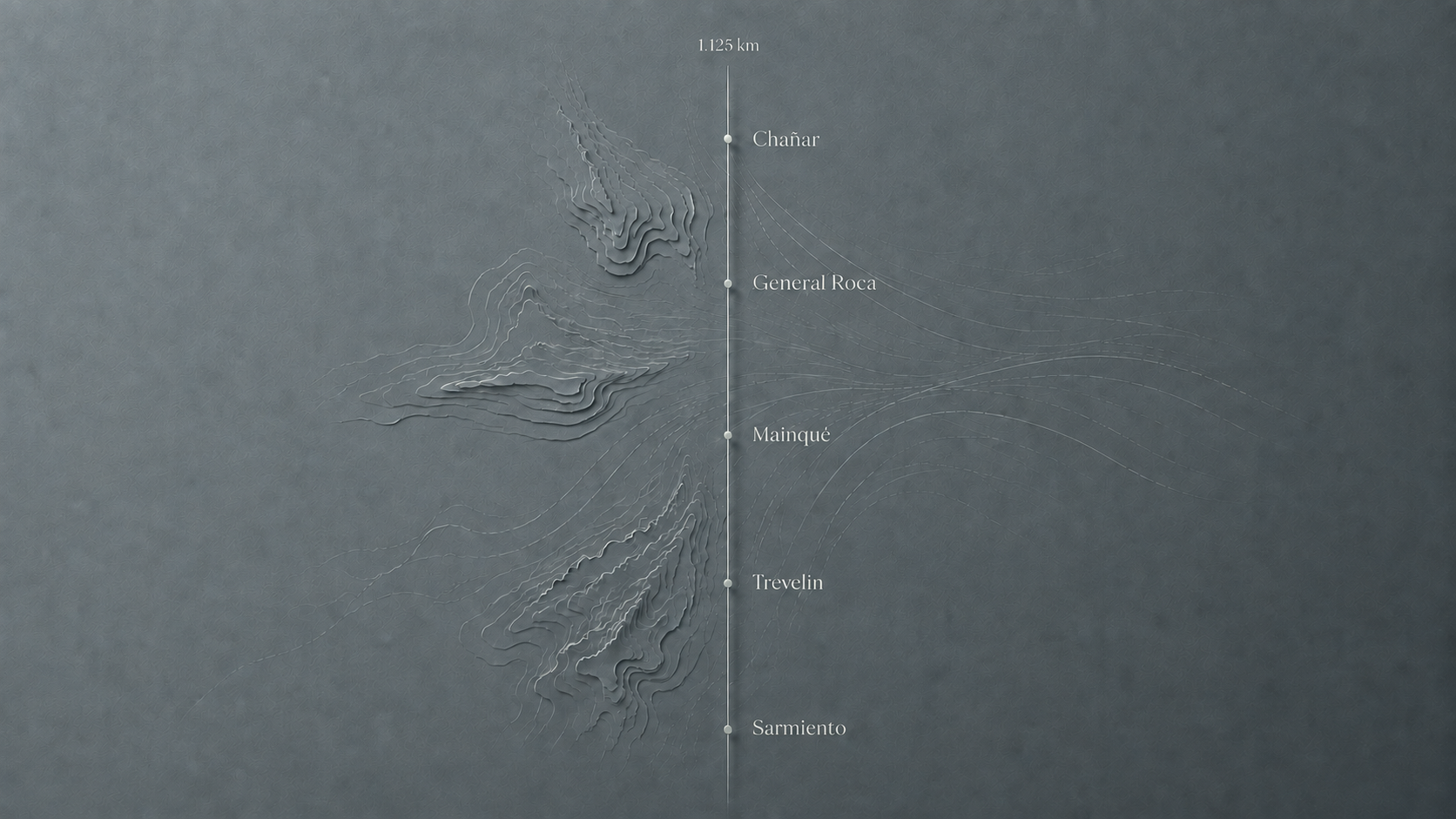
The geographical scale makes that task demanding. The road distance from Neuquén to Sarmiento in Chubut is around 1,125 kilometres. Sarmiento, home to Otronia’s vineyards, is itself an established wine-growing location. A Patagonian wine route can therefore hardly operate like a compact route where visitors travel from one bodega to the next in a single day.
Building this regional level already requires substantial coordination within Patagonia.
Different tourism structures, provincial administrations, associations, producers and local priorities add another layer. This raises very practical questions: Which sub-routes make geographical sense, how should the individual wine-growing areas be classified, how can maps and information be kept up to date, which events should be communicated jointly and what role should Neuquén, Río Negro and Chubut play within the regional framework?
Caminos y Sabores in Buenos Aires showed a few months later that cooperation across provincial borders is possible. For the first time in the event’s 20-year history, Río Negro and Neuquén shared a stand. Under the banner “Origen Patagonia”, production, wine, gastronomy, tourism and craftsmanship were presented together.
Building this regional level already requires substantial coordination within Patagonia. Outside Argentina, the task becomes even greater because direct familiarity with the individual places is largely absent. Neuquén, Río Negro, San Patricio del Chañar, Mainqué, Trevelin and Sarmiento first need to be located geographically and understood in context before their differences can carry any meaning.
What translates to Germany, Austria, and Switzerland
An example from the German wine trade shows what this kind of orientation can look like.
Alpina Wein presents Patagonia as a region and then structures its editorial content around Río Negro, Neuquén and Chubut. Río Negro is contextualised through its longer wine-growing history and old vineyards, Neuquén through its more modern development and San Patricio del Chañar, Chubut through its much more southerly location and extreme conditions.
Alpina does not represent the entire German market. What matters is the retailer’s initiative: it considers this differentiation crucial enough to undertake the geographical translation itself.
Producers and institutions therefore give up some influence over how their own origin is communicated outside Argentina.
That raises a strategic question for Patagonia. If this structure is only created by individual retailers, importers or journalists, those market actors decide for themselves which places to explain, which differences to highlight and which information is left out. Producers and institutions therefore give up some influence over how their own origin is communicated outside Argentina.
A shared regional framework provides a reference point of its own: Which geographical levels matter, what distinguishes them, which producers illustrate specific developments and what information does someone in Europe need to understand those differences?
A concrete example shows what this can change in communication. A German journalist receives three Pinot Noirs from Patagonia, one from Neuquén, one from Río Negro and one from Chubut. With “Patagonia” as the only geographical information, they remain three wines from the same broad region. With good geographical context, a different story emerges: Why do Pinot Noirs from San Patricio del Chañar and Mainqué differ, what role do old vines play in Río Negro, what changes further south in Chubut and how far does Patagonia as a wine origin actually extend?
Three bottles become a tangible story about origin.
Making that possible outside Argentina requires useful material: clear maps and origin hierarchies, comparative tastings and masterclasses, regional contacts, press themes that bring several producers together around a coherent question and precise information about the differences between sub-regions.
A Patagonia tasting in Germany, for example, could compare Pinot Noir from Neuquén and Río Negro directly. A masterclass could explain the same grape variety across several locations, while a map shows where San Patricio del Chañar, Mainqué, Trevelin and Sarmiento actually are. The geographical name then gains concrete places, differences and people that sommeliers, retailers and journalists can work with.
Origin needs repetition and precision
Patagonia already has a strong geographical name. The wine origin behind that name is becoming more detailed.
Bodegas develop their own wines and identities, restaurants place them in a gastronomic context, sommeliers explain them, tourism connects them with landscape and history, events bring producers and audiences together, institutions create structures and joint formats make individual places visible within a regional context.
The task is clear: Patagonia needs to structure its growing diversity itself and translate it into European markets.
Outside Argentina, this translates into concrete work: mapping sub-regions in a way that is easy to understand, bringing producers together where it makes sense, making differences tangible through tastings, providing specialist media with substantial stories and creating a shared framework that importers, retailers and sommeliers can use.
For the next stage of development, the task is clear: Patagonia needs to structure its growing diversity itself and translate it into European markets in a way that keeps Patagonia recognisable as a shared origin while giving the differences between its wine-growing places greater meaning.
1 Matías Prezioso, “Ten Years that Changed Argentine Wine”, IWC Insight. Published: 20 August 2026.
2 Gobierno de la Provincia del Neuquén, “La ciudad de Neuquén celebra con vinos, gastronomía y experiencias”. Published: 19 August 2026, activities through 23 August 2026.
3 Gobierno de la Provincia del Neuquén, “Neuquén reunió a la cadena vitivinícola para fortalecer la identidad del Pinot Noir”. Published: 19 August 2026, event: 18 August 2026.
4 Gobierno de la Provincia del Neuquén, “Más de 2.000 personas celebraron con La Noche del Pinot”. Published: 23 August 2026, event: 22 August 2026.
5 Gobierno de la Provincia del Neuquén, “En el Festival del Chef, la Provincia actualizó el Sello Gastronómico e incorporó al Embajador del Vino”. Published and first distinction awarded: 2 May 2026.
6 Gobierno de la Provincia del Neuquén, “Ana Grisoni y Daniela Hernández, nuevas embajadoras del vino neuquino”. Published: 28 August 2026, distinction awarded: 22 August 2026.
7 Gobierno de Río Negro, “Vitivinicultura rionegrina: identidad, arraigo y proyección marcaron 2025”. Published: 15 January 2026, reporting period: 2025.
8 Gobierno de Río Negro, “Río Negro reunió a los grandes referentes del vino patagónico”. Published: 22 May 2026, event: 21 May 2026.
9 Gobierno de Río Negro, “Caminos y Sabores: Río Negro y Neuquén juntan la fuerza de la Norpatagonia”. Published: 11 July 2026.
10 Bodega Otronia, official terroir information for Sarmiento, Chubut. Accessed: 31 August 2026. Neuquén–Sarmiento road distance: approximately 1,125 km according to RutaDistancia.
11 Alpina Wein, Patagonia regional page. Accessed: 31 August 2026. Commercial source used here solely as a concrete example of how a German wine retailer geographically structures Patagonia for its market.